Lazy Susan
A lazy susan shot rotates the subject on a motorized turntable while the camera stays put, or the camera circles at a fixed product-hero radius. Distance holds, so scale does not change, and the far wall barely shears if the disc is what turns.

Narrative function
Use it to inspect. A coat, a bottle, a weapon, a figure treated as merchandise: every azimuth is offered without a cut.
Light should stay consistent so the object, not the room, is what changes. It is the wrong tool when geography matters.
If walls, extras, and lamps must slide to prove a living space, you want an orbit. A conversation, a chase, a blocked room: those need the camera to travel.
How it works
The classic rig is a motorized disc under the subject; the camera is locked on sticks at eye or product height, often 50 to 85mm so the silhouette stays clean. Alternate: a circular slider at constant radius with the subject locked.
Either way, nodal distance is constant. Prompt a slow turntable rotation or a camera circling at product-hero distance, one revolution or a 90-degree reveal, no zoom.
When to use it
Show an object or costume from every side: a dress on a dummy, a car on a cyc, a relic on glass. Do not use it for a talk; faces in dialogue do not need a spin.
Compared with similar shots
360-Degree Orbit walks the camera around a living space so walls and extras shear. A lazy susan keeps radius and usually the room still.
3D Rotation treats the figure as a virtual sculpture in computed space. An Arc is a partial circle that still faces a person in a real room.

In film
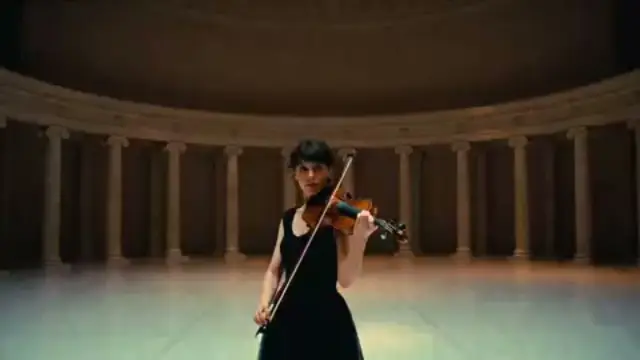
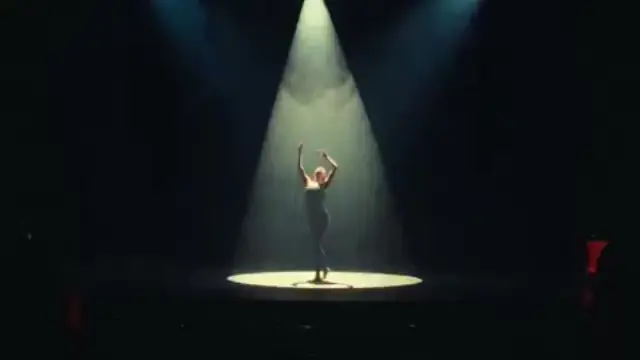
Product films and music-video costume spins are the grammar: perfume turntables, album-cover rotations, a hero prop shown as a specimen. These are inspection uses, not a narrative street orbit.
Prompt it
Quote the move, not a mood. Still: Lazy-Susan rotation of [Subject] on a turntable while the camera stays put, or the camera circles a static product, commercial 360 hero.
Video: [Subject] rotates slowly as if on a turntable, or the camera circles at product-hero distance. Name the object, keep distance constant, forbid a zoom.
What usually goes wrong
The usual wrong cousin is an orbit. The tell: background sliding, a lamp shearing, the room turning.
The fix: lock the camera or lock the subject to a disc, keep radius constant, let only the object rotate.
Questions
What is Lazy Susan in film?
A lazy susan shot rotates the subject on a turntable with the camera locked, or circles the object at a fixed product-hero distance, so every side is shown without a change in scale.
Lazy Susan vs 360-Degree Orbit
An orbit moves the camera through a real room so parallax of walls and extras is the proof. A lazy susan keeps the radius and usually the background still; the object turns like a specimen.
When should I use Lazy Susan?
Use it to show a costume, product, or relic from every side. Skip it when the location has to act; then orbit or arc instead.
How do I prompt Lazy Susan for AI image or video?
Write a turntable rotation or a camera circling at product-hero distance. Name the object, hold distance, and say no zoom. Example: Lazy-Susan rotation of [Subject] on a turntable while the camera stays put.