Long Shot (WS)
wide shotWSLS
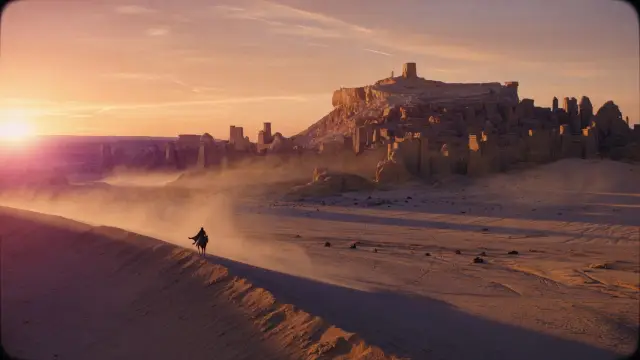
A long shot in cinematography shows the full subject plus a substantial portion of the environment, so a person sits small in geography. The figure is still locatable as a human; the world is large enough to ignore them.
Narrative function
A long shot places a human in a world that could continue without them. You still recognize a body, a walk, a horse, but land, street, or weather takes most of the rectangle.
The sentence is person-in-world, not person-as-portrait. It is the wrong tool when you need the face, the holster, or a complete figure that still owns the height of the frame.
It is also the wrong tool when the person has become an unreadable speck: that is farther still. Use it to locate a body in a place, then go closer for the decision.
How it works
Keep a full figure readable, then add enough architecture or terrain that the person does not fill the height. Working from farther back with a 24mm to 35mm, or from a ridge with a longer lens, both can get you here; the crop is the size.
Deep enough focus that the place reads. Prompt: Long shot of [Subject] small in a large environment, full figure plus geography.
When to use it
Use it to place a human in a world that could ignore them: a rider on a ridge, a coat on a platform, a body in a square. Do not use it to read an eyelid, and do not use it when you only needed head-to-toe as a portrait.
Compared with similar shots
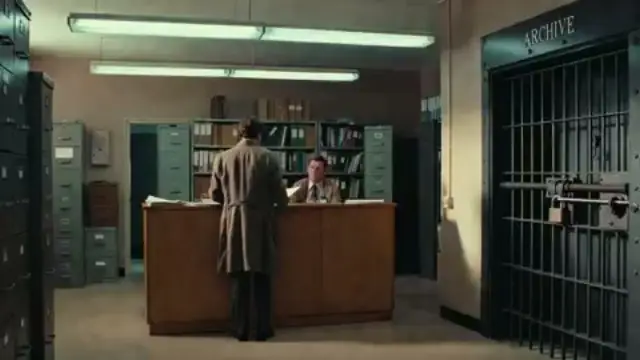
A Full Body keeps the person large, head to toe, with place as a border. A Wide Shot is environment-forward coverage: place still speaks, often as the map of a scene.
An Extreme Long Shot turns the figure into a speck and gives the land the subject. Long shot is full figure plus geography, not those three.
An Establishing Shot is a job (where and when), which may use this size.
In film
Lawrence of Arabia sets riders in desert so the person is still a figure and the land is already huge. Seven Samurai plants bodies in village dirt and fields the same way.
Grammar: locatable human, large world, not a postage-stamp speck and not a costume portrait.
Prompt it
Say full figure plus geography. Example: Long shot of [Subject] small in a large environment, full figure plus geography.
Do not write head to toe as a hero portrait, and do not write speck against vast terrain. For video, keep the body identifiable; if they vanish into texture, you have gone to extreme long shot.
What usually goes wrong
The usual wrong cousin is a Full Body (person fills the height) or an Extreme Long Shot (speck). The tell is either a fashion lookbook figure or a landscape with no readable human.
Fix: full figure visible, world dominant, person still a person.
Questions
What is Long Shot in film?
A long shot shows a full subject and a substantial portion of the environment, so a person is small in a large place but still readable as a figure. It is a size, not automatically an establishing shot.
Long Shot vs Wide Shot
A long shot is the person-in-world size: full figure plus geography. A wide shot is environment-forward coverage whose job is to let place speak and not isolate yet. They overlap in the wild, but wide is a coverage attitude; long is the figure-plus-land sentence.
When should I use Long Shot?
Use it to locate a human in a place large enough to ignore them. Do not use it for faces, and do not use it when you wanted a full-body portrait or a speck-scale landscape.
How do I prompt Long Shot for AI image or video?
Write Long shot of [Subject] small in a large environment, full figure plus geography. Keep the body identifiable. Do not say head-to-toe hero and do not say speck.